Finance teams already have systems of record.
Accounting systems record transactions. ERPs store financial data. CRMs track sales activity. HR systems manage people data. BI tools show dashboards.
But the actual work of planning still happens somewhere else.
It happens in spreadsheets, exports, review calls, Slack threads, board decks, and monthly follow-ups.
Finance teams spend weeks collecting inputs, cleaning data, checking assumptions, rebuilding models, explaining changes, and turning numbers into a plan the company can trust.
The systems record the business.
But they do not help finance teams run the work.
That is why we are building Oculon.
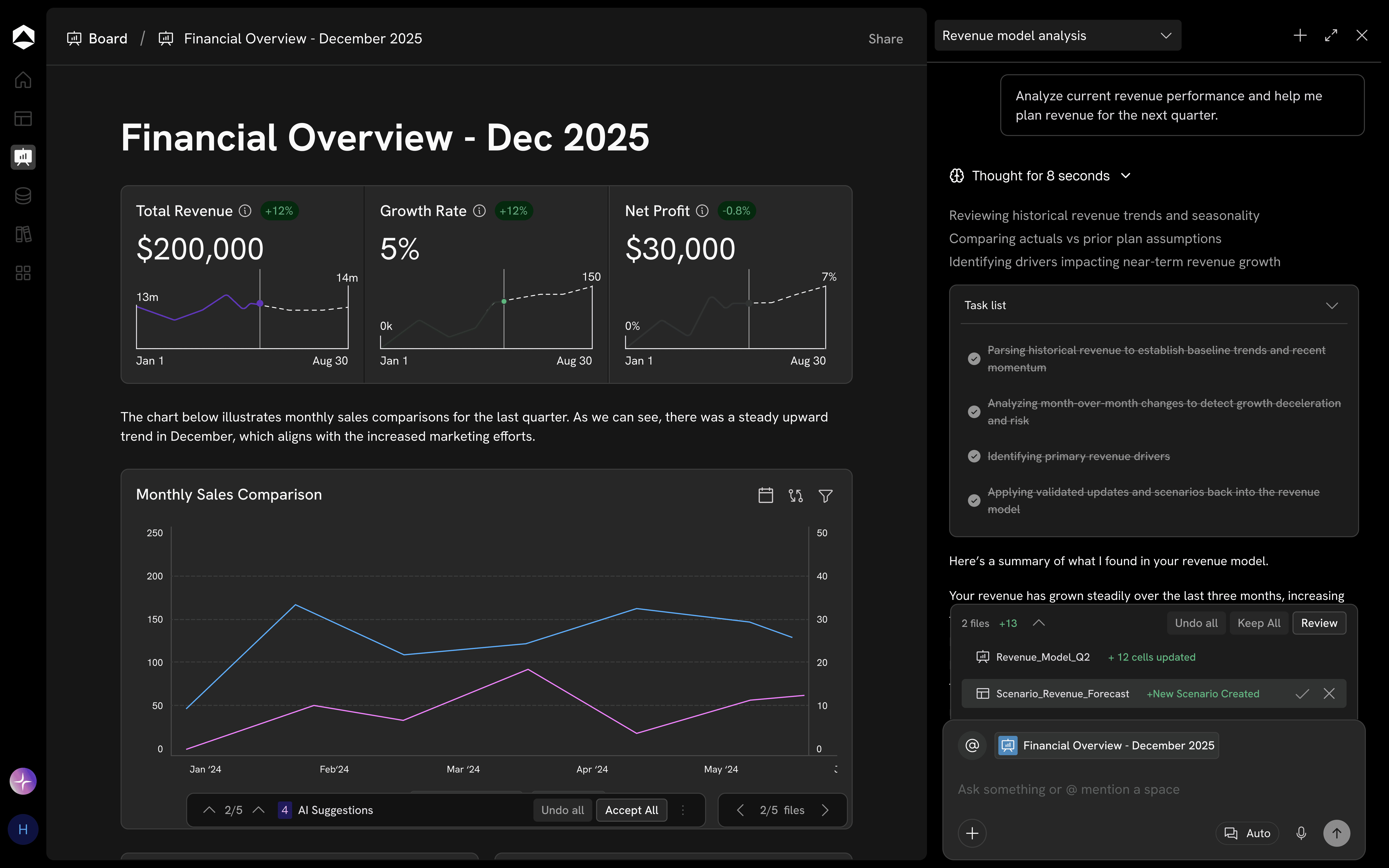
Oculon is an AI-native planning workspace for finance teams. It helps teams connect data, build models, create live planning views, investigate changes, and move planning work forward from one place.
From system of record to system of action
A system of record tells you what happened.
A system of action helps you decide what to do next.
Finance planning needs both.
You need accurate actuals from your systems of record. But you also need a place where those numbers become assumptions, scenarios, forecasts, decisions, and actions.
That is the gap Oculon is built for.
Oculon sits above your existing systems and turns disconnected data into a working planning layer for finance.
Instead of starting every planning cycle from a blank spreadsheet, teams can build a connected planning workspace that stays useful month after month.
Why planning needs to change
Planning is one of the most important jobs in finance, but it is still too manual.
Most teams deal with the same problems every cycle:
Data comes from too many systems
Assumptions are scattered across files
Definitions are inconsistent
Models are hard to maintain
Stakeholder inputs are difficult to track
Forecast changes are hard to explain
Reports are rebuilt again and again
Finance becomes the bottleneck for every decision
This is not because finance teams are slow.
It is because the tools around them were not designed for the way finance work actually happens.
Finance is not just data entry. It is judgment, structure, context, tradeoffs, and decision support.
Oculon is designed around that reality.
Built for finance people first
We are building Oculon for CFOs, FP&A teams, founders, finance operators, and business partners.
The goal is to create a platform that feels natural to finance teams, not something that requires them to think like engineers or depend on long implementation projects.
Finance teams should be able to connect data, define drivers, build models, create planning views, review performance, and answer stakeholder questions without fighting the system.
Oculon is designed to be powerful, but also calm, clear, and easy to use.
The product should feel like it was made with care for the people who actually run planning.
Because finance teams deserve better software.
What Oculon helps you do
Oculon brings the core parts of planning into one AI-native workspace.
1. Connect your planning data
Planning depends on data from accounting systems, billing tools, CRMs, HR systems, spreadsheets, and internal reports.
Oculon helps bring that data into a structured finance workspace.
The goal is not to replace your systems of record.
The goal is to make their data useful for planning.
Once connected, your actuals, drivers, assumptions, and dimensions can work together instead of living in separate files.
2. Build models that stay connected
Finance models should not break every time the business changes.
In Oculon, teams can build planning models around the way their business works: revenue drivers, headcount, expenses, departments, projects, assumptions, scenarios, and KPIs.
Models can connect to actuals and shared definitions, so teams do not need to recreate the same logic across multiple spreadsheets.
When assumptions change, the plan can update with more structure and less manual effort.
3. Create live planning views
Planning is not only about the model.
It is also about helping the company understand the plan.
Oculon lets teams create live boards for planning reviews, leadership updates, department plans, variance analysis, runway views, and scenario discussions.
These views can combine charts, tables, commentary, assumptions, and drilldowns in one place.
Instead of sending static files around the company, finance teams can work from live planning views connected to the underlying data.
4. Investigate what changed
A good planning system should not just show numbers.
It should help explain them.
Oculon helps finance teams understand what changed, where the change came from, and what it means for the plan.
If revenue is below forecast, expenses are rising, hiring is delayed, or cash runway has moved, the workspace should help finance teams get to the answer faster.
The goal is to reduce the time spent hunting for context and increase the time spent making decisions.
5. Use AI agents to move work forward
Planning includes a lot of repetitive work.
Collecting data. Checking assumptions. Comparing versions. Explaining variances. Updating views. Preparing summaries. Answering stakeholder questions.
Oculon uses AI agents to help with that work.
Agents can help build a model, review a forecast, explain a variance, find data issues, summarize plan changes, and prepare planning updates.
They do not replace finance judgment.
They give finance teams leverage.
Finance still owns the context, decisions, and business judgment. Oculon helps reduce the manual work around it.
Moving toward zero implementation
Finance software has historically been too difficult to adopt.
Too many tools require long setup cycles, consultants, rigid configuration, and months of implementation before teams see value.
We believe the next generation of finance systems should work differently.
Teams should be able to start with simple planning workflows, connect their data, use templates, customize what matters, and improve the system over time.
Oculon is being built toward a zero-implementation future for finance planning.
Start simple. Connect what you need. Build the model. Share the plan. Let agents help keep the work moving.
Powerful enough for serious finance teams.
Simple enough to start without a large implementation project.
The future of finance planning
Planning is becoming more continuous, more collaborative, and more connected to how the business actually runs.
Finance teams need more than static models and backward-looking dashboards.
They need a workspace where data, models, assumptions, scenarios, commentary, and decisions come together.
That is what we are building with Oculon.
A system of action for finance planning.
A workspace designed with care for finance teams.
A simpler way to plan, forecast, explain, and run the numbers.
Welcome to Oculon.
Manav Joshi
Co-founder and CEO,
Oculon AI