Oculon vs ChatGPT & Claude
Give AI the consistent context to make financial decisions useful. ChatGPT and Claude are already excellent at reasoning, analysis and problem-solving. Keep using them for what they do best, and connect them to Oculon so they can work from your company’s financial context: the models, metrics, assumptions, definitions and controls behind the numbers.
Question
AI assistants like ChatGPT & Claude
Oculon
Where does the financial context come from?
Whatever data, files, instructions or connected sources are available to the interaction
Models, metrics, assumptions, definitions and connected data already live in the financial environment
Does it know how your business calculates the number?
Can reason about the logic once it is provided
Works with the formulas, drivers and definitions behind the financial model
Does that context persist?
Context can be distributed across chats, files and tools
Financial and workspace context can persist across workflows
What controls surround the work?
Depends on the assistant and the systems connected to it
Finance permissions, sandboxes and review controls sit around the financial workflow
Where does the answer go next?
Often needs to be verified or carried back into the finance workflow
Analysis happens inside the environment where finance models and plans
From context stitching to context-native finance
How ChatGPT and Claude work with Oculon
Connect the assistants your team already uses to the financial context in Oculon.
01
Connect
Link your assistant
Connect ChatGPT or Claude to Oculon through MCP or the API, so they can query your models, metrics and definitions.
02
Ask
Ask with the context already there
Answers draw on the approved plan, finance definitions and connected data, without uploading files or re-explaining the metric.
In Oculon
Act inside the financial environment
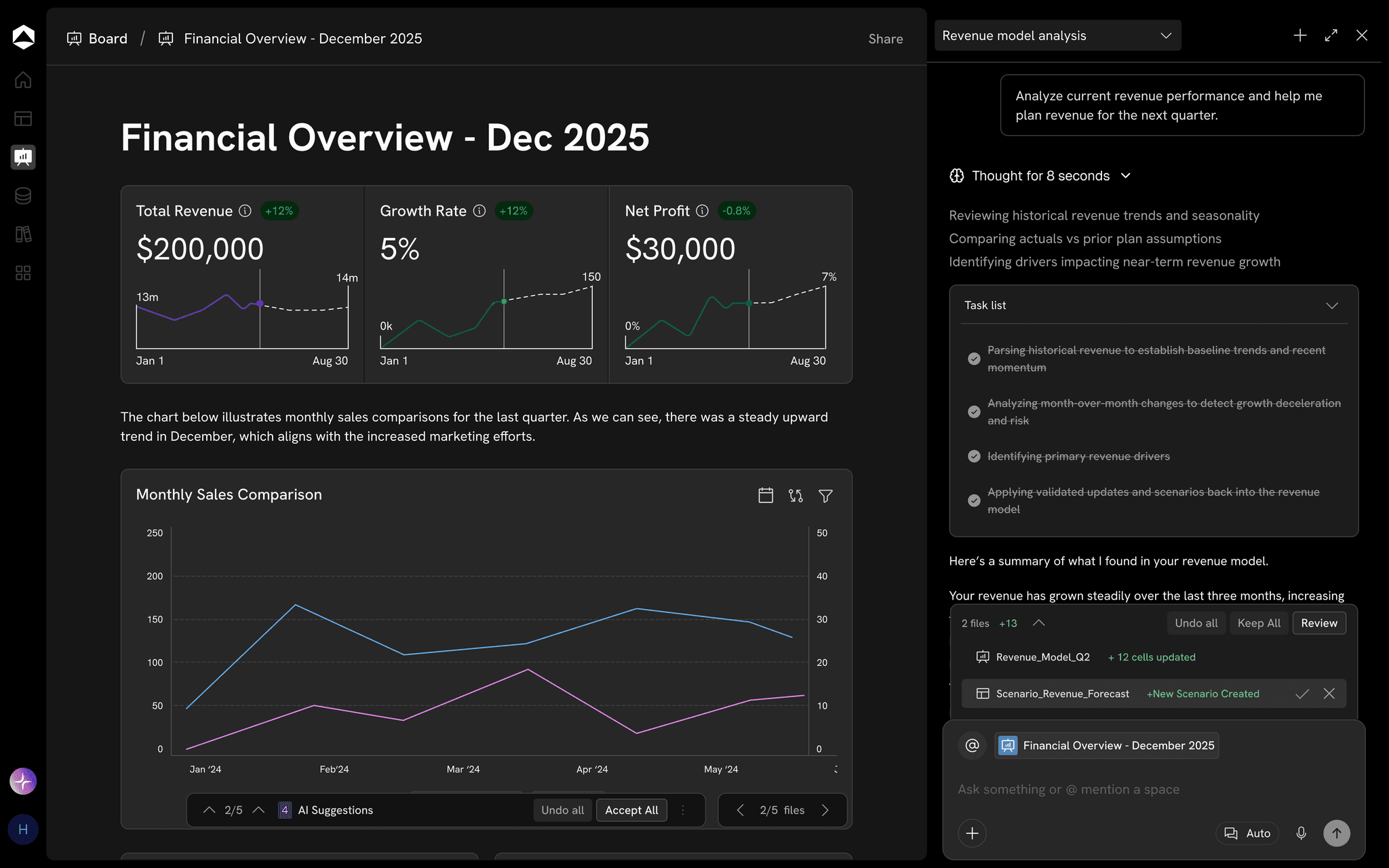
Oculon’s own AI analyses, builds and updates models where finance plans, with permissions, sandboxes and review around the work.
Use ChatGPT, Claude and your team’s tools for research, writing and everything else they do well. Connect them to Oculon when the work depends on your financial system.
Questions about Oculon.
You can, and you can connect them to Oculon through MCP or the API. They are useful for research, analysis, spreadsheet work and many one-off finance tasks.
Oculon is designed for work that depends on the financial context already inside your planning system: the models, definitions, assumptions, data and controls behind the answer.
What financial context does Oculon understand?
Does Oculon remember our company context?
How can we trust the answers?
Can Oculon change our financial models?
Who controls what Oculon can access?
Is Oculon just a chatbot for financial data?
Do we have to stop using our existing AI tools?
Oculon vs ChatGPT & Claude
Give AI the consistent context to make financial decisions useful. ChatGPT and Claude are already excellent at reasoning, analysis and problem-solving. Keep using them for what they do best, and connect them to Oculon so they can work from your company’s financial context: the models, metrics, assumptions, definitions and controls behind the numbers.
Where does the financial context come from?
Whatever data, files, instructions or connected sources are available to the interaction
Models, metrics, assumptions, definitions and connected data already live in the financial environment
Does it know how your business calculates the number?
Can reason about the logic once it is provided
Works with the formulas, drivers and definitions behind the financial model
Does that context persist?
Context can be distributed across chats, files and tools
Financial and workspace context can persist across workflows
What controls surround the work?
Depends on the assistant and the systems connected to it
Finance permissions, sandboxes and review controls sit around the financial workflow
Where does the answer go next?
Often needs to be verified or carried back into the finance workflow
Analysis happens inside the environment where finance models and plans
From context stitching to context-native finance
How ChatGPT and Claude work with Oculon
Connect the assistants your team already uses to the financial context in Oculon.
01
Connect
Link your assistant
Connect ChatGPT or Claude to Oculon through MCP or the API, so they can query your models, metrics and definitions.
02
Ask
Ask with the context already there
Answers draw on the approved plan, finance definitions and connected data, without uploading files or re-explaining the metric.
In Oculon
Act inside the financial environment
Oculon’s own AI analyses, builds and updates models where finance plans, with permissions, sandboxes and review around the work.
Use ChatGPT, Claude and your team’s tools for research, writing and everything else they do well. Connect them to Oculon when the work depends on your financial system.
Questions about Oculon.
You can, and you can connect them to Oculon through MCP or the API. They are useful for research, analysis, spreadsheet work and many one-off finance tasks.
Oculon is designed for work that depends on the financial context already inside your planning system: the models, definitions, assumptions, data and controls behind the answer.
What financial context does Oculon understand?
Does Oculon remember our company context?
How can we trust the answers?
Can Oculon change our financial models?
Who controls what Oculon can access?
Is Oculon just a chatbot for financial data?
Do we have to stop using our existing AI tools?