Oculon vs Legacy FP&A
Built for the speed of modern finance. Legacy FP&A platforms can handle complex planning. Oculon is built for finance teams to build, analyse and adapt as the business moves, with less implementation drag, platform administration and specialist dependency.
How Oculon compares
Both approaches can support sophisticated financial planning. The difference is how quickly finance can get started, adapt the model, understand what changed and act.
Question
Legacy FP&A
Oculon
Multidimensional modelling
Mature multidimensional modelling
Variables, formulas, drivers, dimensions and hierarchies
Scenario planning
Scenario and version planning
Branch, compare, govern and merge scenarios
Enterprise governance
Mature permissions, controls and audit capabilities
Permissions, versions, approvals, sandboxes and audit history
Time to value
Longer implementation, data mapping and model configuration
Connect your sources, define your model, start planning
Integrations
Integrations can require more mapping, middleware or implementation support
Connect finance and operating systems directly and select the tables and fields you need
Changing the plan
Larger changes can require admins, model builders or reconfiguration
Finance can change drivers, assumptions, dimensions and structures directly
Analysis & root cause
Analysis typically relies on drilling through configured reports and models
Variance → driver → explanation in one workflow
AI & agents
AI is increasingly available, usually within existing planning and reporting workflows
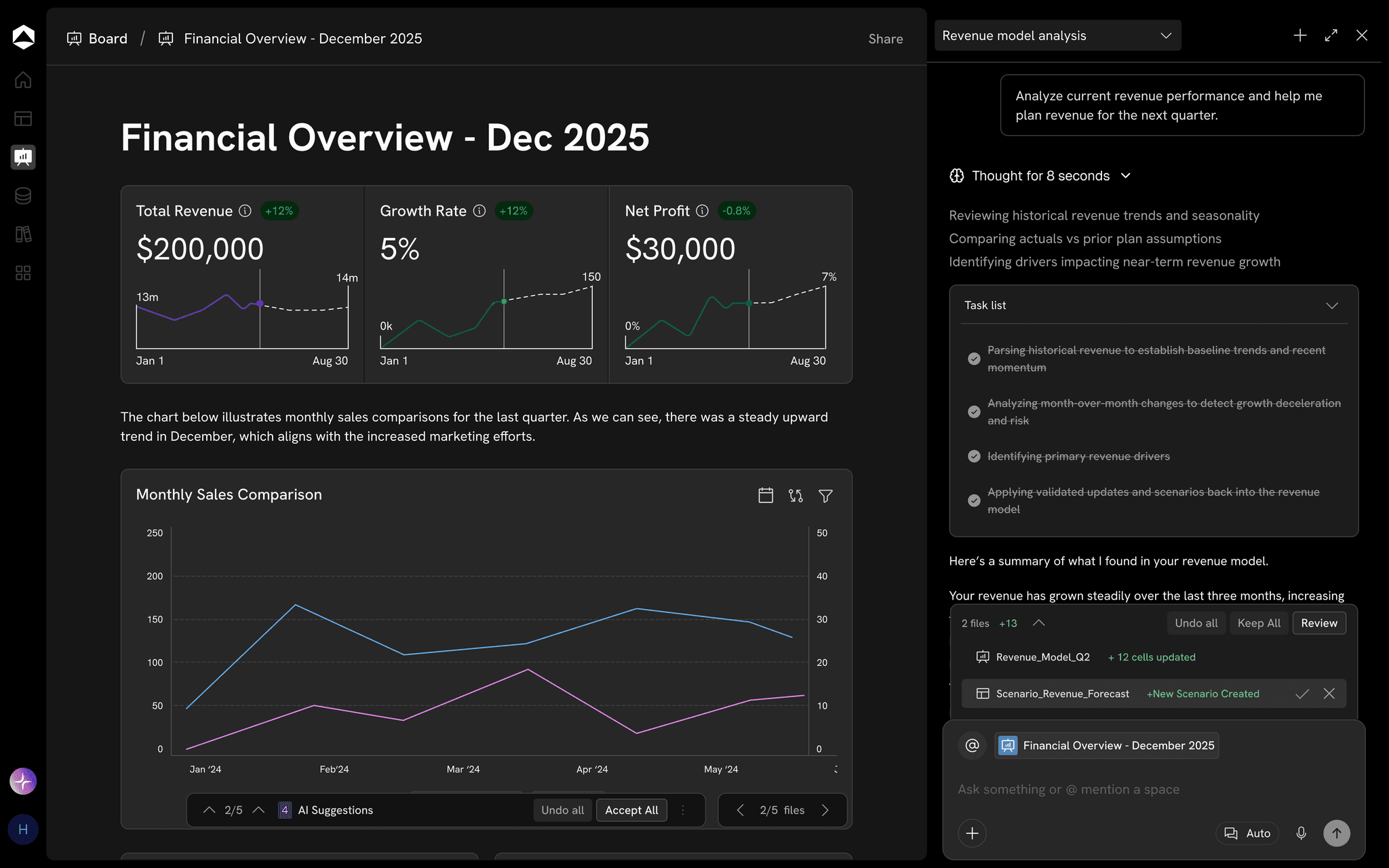
AI understands the financial model, builds scenarios and can propose governed changes
Continuous monitoring
Primarily report- and dashboard-led, with monitoring dependent on configuration
Automatically surfaces material changes, risks and exceptions
Insight → action
Follow-up often continues across separate workflows or execution tools
Move from analysis into scenarios, approvals and governed workflows
Day-to-day administration
Can involve dedicated admins, model builders or platform owners
Designed for finance teams to work directly
Total cost of ownership
Licence + implementation + administration + maintenance + partner or consultant support
Lower implementation and ongoing platform overhead
When should you consider switching?
When updating a planning platform takes more time than decision-making, the tool has become the bottleneck.
Signal 01
The plan is always catching up
Changes in entities, structures or assumptions take too long to reflect in the model.
Signal 02
New questions require new setup
Getting an answer means building another report, view or model before analysis can begin.
Signal 03
Scale creates more overhead
More teams, scenarios and complexity bring more administration, configuration and specialist support.
Signal 04
The real cost keeps growing
Implementation, maintenance, administration and specialist support make the platform increasingly expensive to run.
Questions finance teams ask before switching.
No. Oculon connects to the financial and operating systems you already use, so your source systems can remain in place. Finance can select the data it needs and use it across modelling, planning and analysis.
How long does implementation take?
What happens to our existing models and planning logic?
Do we need a dedicated implementation partner or platform admin?
Can Oculon handle complex and highly customised financial models?
Can non-finance teams use Oculon?
How does Oculon pricing compare with legacy FP&A platforms?
How are changes controlled and audited?
Can AI change our financial models automatically?
Is our financial data secure?
A seamless switch
Switch to a modern finance workspace without replacing the systems your business already runs on or taking on another big-bang implementation.
1
Connect the systems you already use
Bring your financial and operational data into Oculon by connecting directly to the systems your business already runs on.
Explore integrations
2
Define your finance context
Set the metrics, dimensions, drivers, formulas and structures that reflect how your business actually works.
3
Start planning
Start with the planning, modelling or reporting workflow that matters most. Get it working in Oculon, then expand from there as your needs grow.
Oculon vs Legacy FP&A
Built for the speed of modern finance. Legacy FP&A platforms can handle complex planning. Oculon is built for finance teams to build, analyse and adapt as the business moves, with less implementation drag, platform administration and specialist dependency.
How Oculon compares
Both approaches can support sophisticated financial planning. The difference is how quickly finance can get started, adapt the model, understand what changed and act.
Multidimensional modelling
Mature multidimensional modelling
Variables, formulas, drivers, dimensions and hierarchies
Scenario planning
Scenario and version planning
Branch, compare, govern and merge scenarios
Enterprise governance
Mature permissions, controls and audit capabilities
Permissions, versions, approvals, sandboxes and audit history
Time to value
Longer implementation, data mapping and model configuration
Connect your sources, define your model, start planning
Integrations
Integrations can require more mapping, middleware or implementation support
Connect finance and operating systems directly and select the tables and fields you need
Changing the plan
Larger changes can require admins, model builders or reconfiguration
Finance can change drivers, assumptions, dimensions and structures directly
Analysis & root cause
Analysis typically relies on drilling through configured reports and models
Variance → driver → explanation in one workflow
AI & agents
AI is increasingly available, usually within existing planning and reporting workflows
AI understands the financial model, builds scenarios and can propose governed changes
Continuous monitoring
Primarily report- and dashboard-led, with monitoring dependent on configuration
Automatically surfaces material changes, risks and exceptions
Insight → action
Follow-up often continues across separate workflows or execution tools
Move from analysis into scenarios, approvals and governed workflows
Day-to-day administration
Can involve dedicated admins, model builders or platform owners
Designed for finance teams to work directly
Total cost of ownership
Licence + implementation + administration + maintenance + partner or consultant support
Lower implementation and ongoing platform overhead
When should you consider switching?
When updating a planning platform takes more time than decision-making, the tool has become the bottleneck.
Signal 01
The plan is always catching up
Changes in entities, structures or assumptions take too long to reflect in the model.
Signal 02
New questions require new setup
Getting an answer means building another report, view or model before analysis can begin.
Signal 03
Scale creates more overhead
More teams, scenarios and complexity bring more administration, configuration and specialist support.
Signal 04
The real cost keeps growing
Implementation, maintenance, administration and specialist support make the platform increasingly expensive to run.
Questions finance teams ask before switching.
No. Oculon connects to the financial and operating systems you already use, so your source systems can remain in place. Finance can select the data it needs and use it across modelling, planning and analysis.
How long does implementation take?
What happens to our existing models and planning logic?
Do we need a dedicated implementation partner or platform admin?
Can Oculon handle complex and highly customised financial models?
Can non-finance teams use Oculon?
How does Oculon pricing compare with legacy FP&A platforms?
How are changes controlled and audited?
Can AI change our financial models automatically?
Is our financial data secure?
A seamless switch
Switch to a modern finance workspace without replacing the systems your business already runs on or taking on another big-bang implementation.
1
Connect the systems you already use
Bring your financial and operational data into Oculon by connecting directly to the systems your business already runs on.
Explore integrations
2
Define your finance context
Set the metrics, dimensions, drivers, formulas and structures that reflect how your business actually works.
3
Start planning
Start with the planning, modelling or reporting workflow that matters most. Get it working in Oculon, then expand from there as your needs grow.