
If every forecast cycle starts with copying last month’s workbook, extending a few columns and fixing formulas, you are not really running a rolling forecast.
You are rebuilding one every month.
A rolling forecast should work differently: actuals replace forecast periods as they close, the horizon moves forward, assumptions that still hold stay in place, and finance updates only what changed.
A simple way to think about it is the ROLL framework.
What is a rolling forecast?
A rolling forecast is a financial forecast that maintains a constant forward-looking horizon by adding a new period whenever the latest period closes.
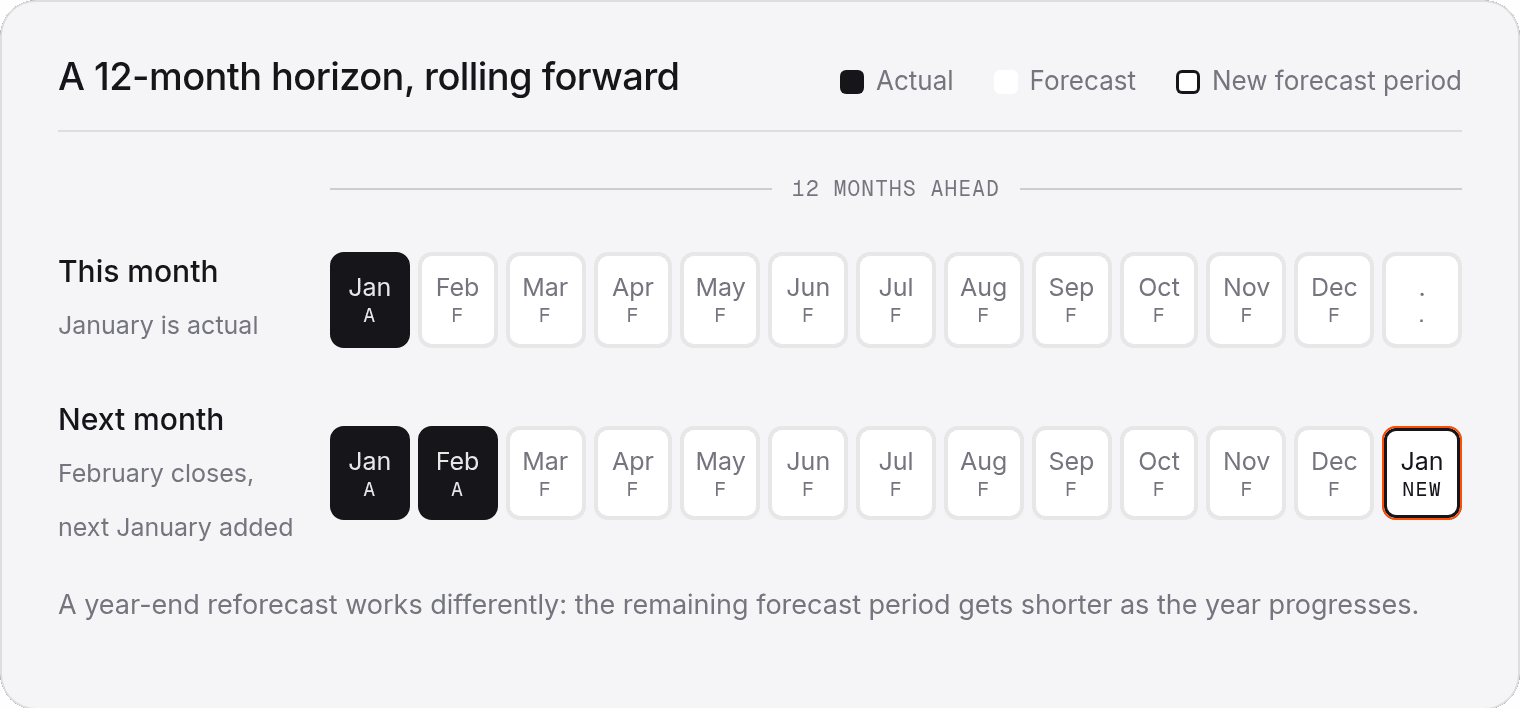
For example, a 12-month forecast may run from January to December. Once January closes, January becomes actual and the forecast moves to February through the following January. You still have 12 months ahead.
The challenge is not building the first forecast. It is designing it so the next cycle does not require rebuilding the model.
Refresh actuals
Every cycle begins by replacing forecast periods with actuals and moving the horizon forward. If January closes:
January becomes actual
February becomes the first forecast month
the following January is added at the end
The same principle applies to the underlying information. Revenue, contracts, pipeline, headcount and costs should refresh without finance recreating the inputs every month.
Refresh the information, not the model.
Own assumptions
Historical data tells you what happened. A forecast requires a view on what happens next. For a service business, that may mean assumptions about pipeline conversion, project timing, hiring, utilization, pricing and operating costs.
Each material assumption should carry enough context to answer five questions:
A useful rule:
If no new information has arrived, why are you changing the assumption?
Every carried-forward assumption should eventually be kept, challenged or retired.
This is also a useful role for AI. Instead of immediately asking it to build a forecast, ask:
AI can surface the questions. Finance and the business still own the answers.
Link drivers
The easiest forecast to maintain is usually the one where financial outcomes are connected to the few business drivers that actually move them. For a service business:
Now a revenue miss can be traced to pipeline, utilization, pricing, capacity or timing rather than appearing as one unexplained variance.
Say January closes at 70% utilization versus a 75% assumption, while a new April contract has just been signed. You do not rebuild the revenue forecast.
Learn from change
A rolling forecast should preserve what the business previously believed. Keep four views distinct:
The useful question is not only:
It is:
That movement might come from a delayed contract, lower pipeline conversion, utilization or hiring timing.
This is where maintaining forecast versions helps. In Oculon, finance can preserve planning checkpoints and compare forecast states rather than reconstructing changes manually.
And once actuals arrive:
A forecast miss is only useful when you can trace it back to the assumption that missed.
If revenue misses by 8%, find the driver. Was pipeline conversion wrong? Did the project start late? Was utilization weaker? Or was the assumption reasonable and the underlying conditions changed?
The point is not simply to measure error. It is to improve the next forecast.
Keep uncertainty in scenarios
The main forecast should represent the team’s current expected view. For material uncertainty, use scenarios instead of continually changing the base case.
That lets finance test different futures without muddying the shared forecast.
If you’re using AI, give it the financial context
Do not just upload a P&L and ask AI to forecast the next 12 months. Give it:
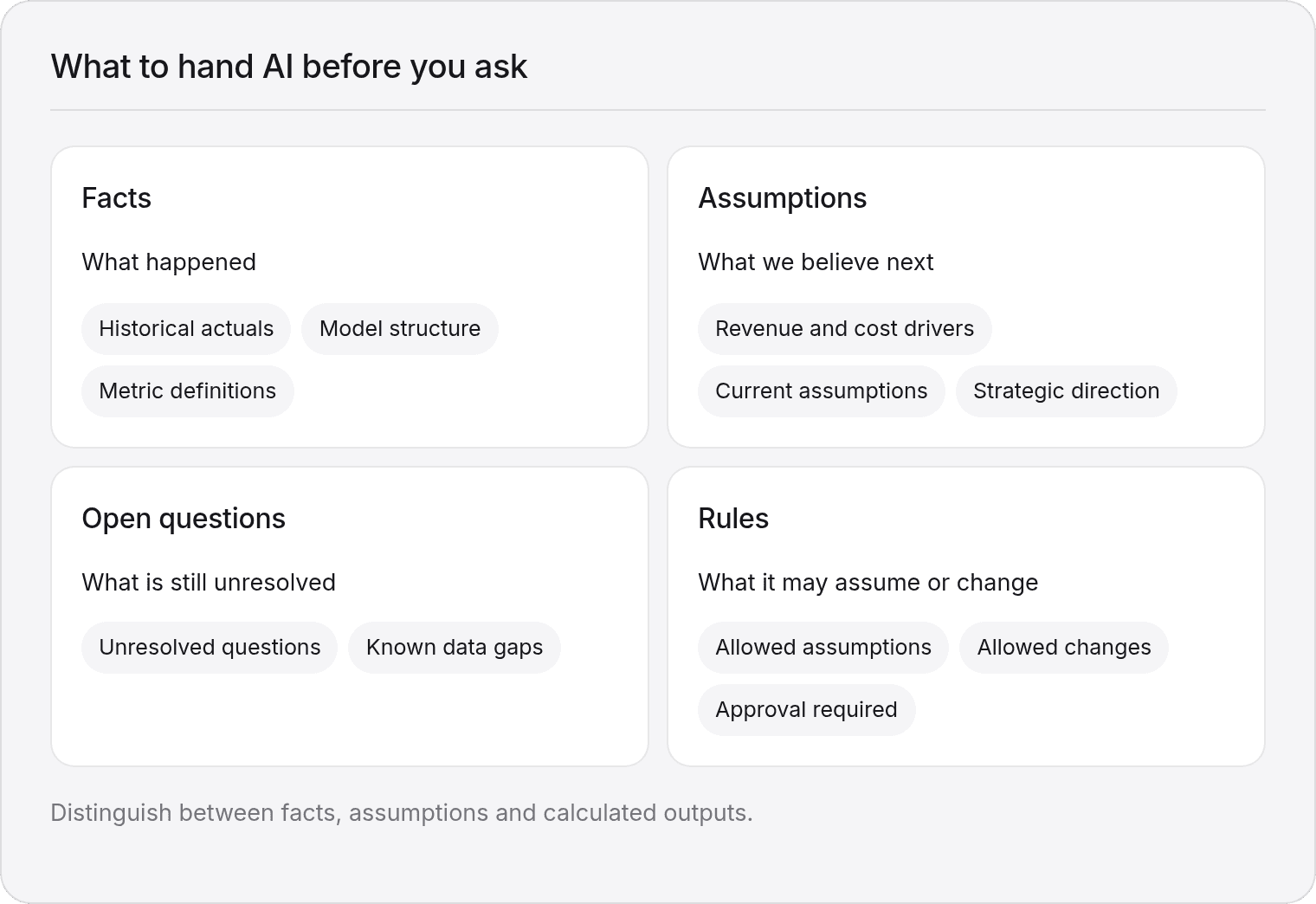
That context is what lets AI challenge an assumption, build useful model logic or explain why the forecast moved without inventing what is missing.
With a general AI tool, you may need to recreate that context between workflows. With Oculon, financial context can persist across interactions, such as metric definitions, fiscal-year conventions or the approved scenario, so the next analysis can start with that context already available.
Give AI the context before you ask it for the answer.
Rolling forecast implementation checklist
Before the first cycle, check that you can answer yes to these:
The monthly cycle
Once the model is set up, the recurring process should be simple:
A rolling forecast should be easy to roll. That sounds obvious. In practice, finance teams still spend too much time rebuilding the machinery before they can update the answer.
With Oculon, building and updating a forecast is the easy part. Your data stays connected. Your drivers and assumptions stay in context. Your previous forecast is still there to compare against. When something changes, you update the assumption and see the impact flow through the model.
So finance can spend less time maintaining the forecast and more time deciding what to do with it.